Australia’s renewable energy development market is becoming more selective, more commercially disciplined, and increasingly driven by long-term project confidence.
While demand for experienced Development professionals remains strong across wind, solar, BESS and transmission infrastructure projects, hiring conditions have changed significantly over the past 12–18 months.
Professionals are still open to opportunities, but movement is becoming more deliberate. Project quality, leadership, organisational stability, flexibility and long-term development pipelines are now influencing hiring outcomes as much as remuneration itself. The financial backing and stability of a project is being discussed as early as pre-screening phone conversations with target candidates.
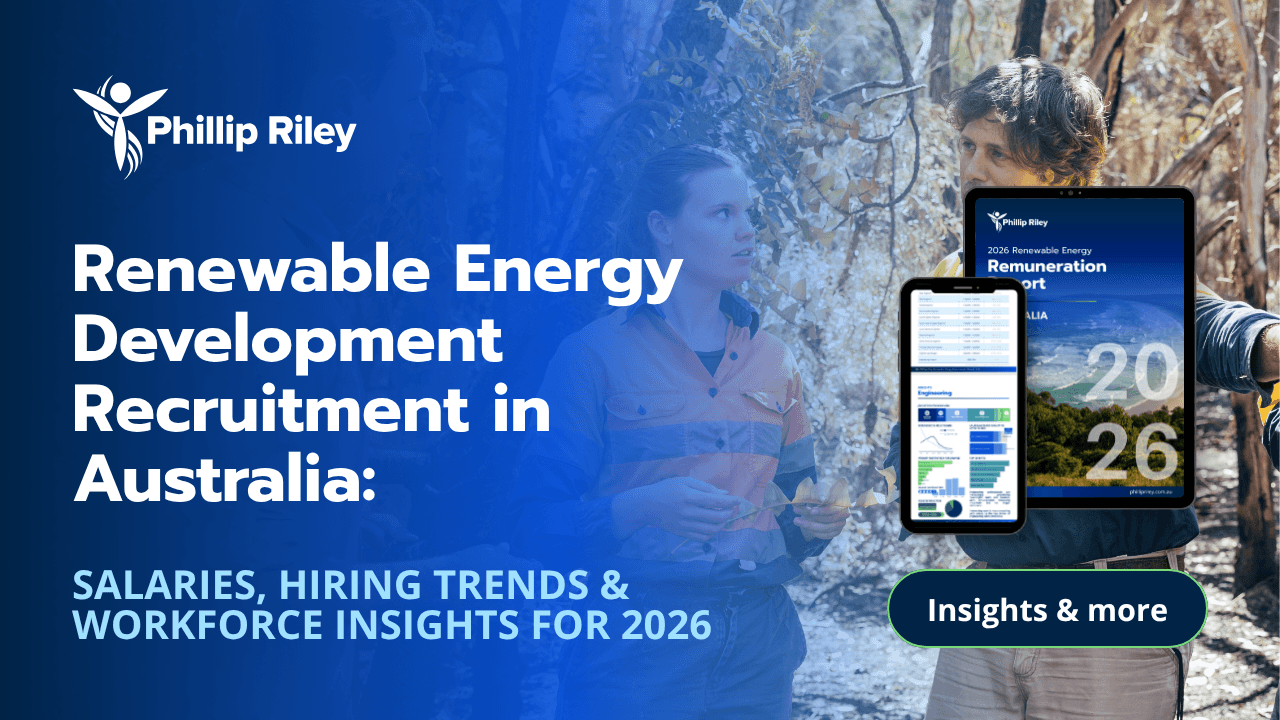
Phillip Riley’s 2026 Renewable Energy Remuneration Report found that Development professionals are placing greater weight on meaningful work and career progression, even as salary expectations continue to rise.
For employers, this means attracting talent now requires far more than simply offering a competitive salary.
For candidates, standing out increasingly depends on demonstrating commercial capability, stakeholder engagement experience, and the ability to navigate increasingly complex project environments. Employers want to see candidates who can wear multiple hats rather than those who are siloed into one area, such as land access manager or planning.
2026 Development Recruitment Snapshot
- Development talent remains highly mobile
- Interesting work outranks salary
- Grid delays impacting hiring confidence
- Experienced Development Managers remain scarce
In This Article
The Renewable Energy Development Market Has Matured
Australia’s renewable energy sector continues to expand rapidly, but the workforce market supporting that growth is evolving.
The aggressive salary inflation and reactive hiring conditions seen across previous growth cycles are beginning to stabilise. Phillip Riley’s 2026 data shows most professionals are now receiving salary increases within the 0–5% range, with expectations becoming more aligned to actual market outcomes.
At the same time, professionals are becoming increasingly selective about:
- project credibility
- delivery certainty
- executive leadership
- career progression
- organisational structure
- flexibility
- long-term project pipeline
This is particularly true within Development functions, where restructures, delayed approvals, funding uncertainty and shifting project timelines have created a more cautious workforce environment.
Phillip Riley’s research found that many Development professionals remain engaged in the market, but are becoming more selective about where they move.
This has created a highly passive candidate market.
Most experienced professionals are not actively applying for jobs. They are evaluating opportunities privately and carefully.
For employers, recruitment has become increasingly relationship-driven rather than advertisement-driven.
Why Renewable Energy Development Recruitment Is Challenging
Development recruitment within renewable energy has always been highly specialised.
Today, it is becoming even more nuanced.
Employers are competing for a relatively small pool of professionals who combine:
- commercial understanding
- land and stakeholder capability
- planning and approvals experience
- technical literacy
- grid knowledge
- project finance awareness
- political and community engagement capability
The strongest candidates often possess experience across multiple project lifecycle stages, from origination through approvals and into financial close or construction transition.
At senior levels, this capability becomes exceptionally scarce.
Phillip Riley continues to see the strongest demand across for Development Managers with greater than five years experience inclusive of grid expertise. Secondary demands also exist for:
- Project Development Managers
- Senior Development Managers
- Grid Connections Engineers
- Land Access Managers
- Stakeholder Engagement Managers
- Head of Development roles
- Origination Managers
This aligns directly with the 2026 Remuneration Report salary benchmarking data.
Many organisations also underestimate how interconnected hiring decisions have become within Development teams.
Candidates are increasingly assessing:
- project viability
- leadership quality
- internal capability
- funding confidence
- approval risk
- delivery maturity
- organisational reputation
before progressing through recruitment processes.
Renewable Energy Development Salary Benchmarks in Australia
Salary expectations across renewable energy development roles remain strong in 2026, particularly for experienced professionals with demonstrated delivery capability.
Phillip Riley’s latest remuneration data highlights the following salary ranges across Australia.
Renewable Energy Development Salary Guide 2026
| Role | Salary Range |
| Project Development Officer | $90,000 – $130,000 |
| Project Development Manager | $150,000 – $210,000 |
| Senior Project Development Manager | $230,000 – $270,000 |
| Head of Project Development | $260,000 – $320,000 |
| General Manager Development | $320,000 – $380,000 |
| Country Manager / CEO | $350,000 – $550,000+ |
| Land Access Manager | $150,000 – $190,000 |
| Grid Connections Manager | $240,000 – $280,000+ |
| Head of Grid Connections | $260,000 – $320,000+ |
Salary outcomes continue to vary significantly depending on:
- project stage
- technology type
- ownership structure
- employer brand
- delivery capability
- geographic location
- incentive structures
The strongest salary growth is generally occurring where employers can demonstrate:
- active project pipelines
- funding certainty
- long-term market commitment
- visible development pathways
What Development Candidates Want in 2026
One of the clearest shifts within the renewable energy workforce is that professionals are increasingly evaluating the “total opportunity”, not just salary.
Phillip Riley’s research found that interesting work is now one of the leading drivers of satisfaction within Development roles, alongside remuneration, work-life balance and career progression.
Key candidate priorities now include:
Meaningful Project Exposure
Candidates want to work on projects that:
- are commercially viable
- are likely to proceed
- have genuine strategic value
- provide visible impact
Project credibility matters.
Career Progression
Development professionals continue to move frequently where progression pathways are unclear.
Mid-career talent in particular remains highly mobile when advancement opportunities stall.
Organisational Stability
Recent market restructures and project delays have increased scrutiny around:
- funding confidence
- executive turnover
- pipeline certainty
- delivery maturity
Job security is playing a larger role in decision-making than previous years.
Flexibility
Flexibility is no longer viewed as a differentiator.
It is now considered a baseline expectation across much of the Development workforce.
Strong Leadership
Candidates increasingly evaluate:
- executive capability
- communication clarity
- decision-making structure
- leadership credibility
before accepting offers.
How Employers Can Improve Renewable Energy Hiring Outcomes
The most successful renewable energy employers in 2026 are no longer relying on reactive recruitment models.
They are proactively building talent relationships before hiring demand becomes urgent.
Based on Phillip Riley’s workforce data and active market engagement, the strongest hiring outcomes are typically achieved when organisations focus on:
1. Recruitment Speed
Top Development professionals rarely remain openly available for long.
Slow hiring processes create major drop-off risk.
Employers with:
- excessive interview stages
- unclear approvals
- delayed feedback
- inconsistent communication
are increasingly losing talent.
2. EVP Clarity
Candidates want clarity around:
- project pipeline
- reporting lines
- leadership structure
- future growth
- funding confidence
- career pathways
Ambiguity creates hesitation.
3. Competitive Base Salaries
Phillip Riley’s data indicates professionals are placing greater emphasis on base salary certainty as confidence in bonus structures softens.
Well-structured base salary positioning is becoming increasingly important.
4. Long-Term Career Positioning
Candidates increasingly want to understand:
- where projects are heading
- future internal mobility
- exposure to broader portfolios
- progression potential
The best employers are selling future opportunity, not just current vacancies.
How Candidates Can Stand Out in Renewable Energy Development
The renewable energy market remains highly competitive for experienced Development professionals.
Candidates who stand out typically demonstrate more than technical capability alone.
The strongest professionals can clearly articulate:
- project delivery outcomes
- stakeholder management capability
- commercial understanding
- regulatory awareness
- risk management capability
- cross-functional collaboration
- project lifecycle exposure
Candidates should focus heavily on demonstrating:
Project Lifecycle Experience
Employers increasingly value professionals who understand the full lifecycle:
- origination
- approvals
- stakeholder engagement
- grid
- commercial structuring
- financial close
- construction transition
Stakeholder Engagement Capability
Community engagement, landowner management and government stakeholder capability continue to be highly valued across Development functions.
Grid & Technical Literacy
Even commercially focused Development professionals increasingly benefit from:
- grid understanding
- transmission awareness
- technical delivery exposure
- NEM familiarity
Commercial Awareness
Candidates who understand:
- project economics
- market conditions
- delivery constraints
- funding environments
often differentiate themselves strongly during hiring processes.
Why Specialist Renewable Energy Recruiters Matter
Renewable energy development recruitment is highly relationship-driven and technically nuanced.
Generalist recruitment approaches often struggle to accurately assess:
- project lifecycle capability
- grid exposure
- stakeholder complexity
- technical-commercial crossover
- market movement behaviour
- passive candidate dynamics
Phillip Riley operates exclusively within the renewable energy, cleantech and decarbonisation sectors, supporting organisations across:
- development
- engineering
- construction
- asset management
- transmission
- executive leadership
- project delivery
Our specialist practice group structure allows our consultants to maintain deep engagement within highly specific talent markets.
This becomes increasingly important in passive candidate environments where the strongest professionals are rarely active applicants.
Phillip Riley’s 2026 Remuneration Report also reinforces the importance of proactive engagement strategies, with most professionals remaining open to opportunities despite not actively seeking change.
In today’s market, specialist networks, industry credibility and long-term relationship management matter more than ever.
The Future of Renewable Energy Development Recruitment in Australia
The Australian renewable energy market is continuing to mature.
Hiring decisions are becoming more strategic.
Candidate movement is becoming more selective.
Employers are being evaluated more critically.
At the same time, demand for experienced Development professionals remains exceptionally strong across:
- wind
- solar
- BESS
- transmission
- utilities
- infrastructure
- emerging technologies
Organisations that can clearly communicate:
- project quality
- leadership capability
- remuneration philosophy
- progression opportunity
- delivery confidence
will be best positioned to attract and retain high-performing talent.
FAQs For Employers Hiring in Renewable Energy Development
How hard is it to hire renewable energy Development professionals in Australia?
Very competitive, particularly for senior professionals with demonstrated project delivery capability across wind, solar, BESS and transmission infrastructure.
What salary does a Senior Development Manager earn in Australia?
Phillip Riley’s 2026 Renewable Energy Remuneration Report shows Senior Project Development Managers typically earning between $230,000 and $270,000 base salary excluding superannuation.
Why are Development professionals difficult to recruit?
The talent pool is relatively small and highly passive. Many professionals are not actively applying for roles, but remain open to compelling opportunities.
What benefits attract renewable energy Development talent?
Flexibility, bonus structures, meaningful project exposure and strong career progression pathways remain highly influential.
Are candidates still motivated primarily by salary?
Salary remains important, but project quality, leadership, stability and career progression are increasingly shaping hiring decisions.
How long does renewable energy recruitment usually take?
Senior Development recruitment processes can often take several months depending on market conditions, project complexity and candidate availability.
FAQs For Candidates Working in Renewable Energy Development
What skills are most valuable in renewable energy Development?
Commercial capability, stakeholder engagement, approvals experience, grid understanding and project lifecycle exposure remain highly valued.
How can I stand out for renewable energy Development roles?
Demonstrate measurable project outcomes, cross-functional collaboration and exposure across multiple project stages.
Are renewable energy salaries still increasing?
Yes, although growth is moderating. Most salary increases are currently sitting within the 0–5% range across the sector.
What motivates professionals to change jobs in 2026?
Career progression, remuneration, meaningful work and long-term project confidence remain the primary drivers.
Is flexibility still important?
Yes. Flexibility is now considered a baseline expectation across much of the renewable energy workforce.
Should I move from traditional infrastructure or utilities into renewables?
Many transferable skills remain highly valuable, particularly across transmission, infrastructure delivery, stakeholder engagement and major project development.
Hiring Renewable Energy Development Talent?
Phillip Riley partners with renewable energy developers, IPPs, utilities, investors, EPCs and infrastructure organisations across Australia to deliver specialist Development recruitment solutions.
Our teams operate exclusively within renewable energy and understand the technical, commercial and market nuances shaping today’s workforce.
Download the latest report or contribute to the Renewable Energy Remuneration Data pool by completing our survey here.